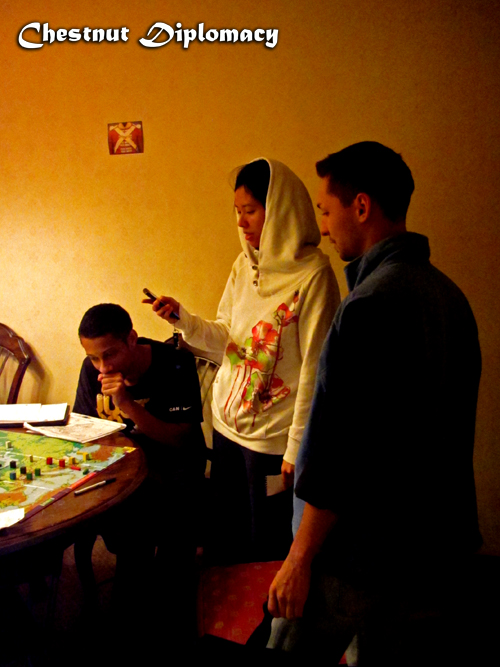
Friends,
Another year, another day, another war: much is afoot in Europe. What are the newspaper criers shouting in city squares across the Continent?
Here's the President's Report from the League of Nations, summarizing the most pertinent issues of La Guerre du Droit in 1902. (With a respectful tip of the hat to the old Archduke.)
I hope you enjoy!
France
---
de Oorlog tot de Beschaving
vol. 1 (1902)
The threat of war looms heavy across Europe. The minor skirmishes of 1901 taking place in the Balkans are giving way to heavy mobilization for military action by Turkey and Austria-Hungary. Serbia is occupied by Austrian troops, and Greece is now ravaged by two years of fighting. The Russian garrison of Romania is under heavy assault from Austro-Hungarian forces.
In a similar fashion, the people of Norway, Sweden, and Finland tremble as heavily armed British, German, and Russian troops move through their cities and towns. It seems that deescalation is not in the books. What we have all feared is coming true: the major Powers or Europe are mobilizing for war. Meanwhile, German and Russian troops wander throughout Central Europe with complete disregard for national borders, adding to the spreading panic.
The Theatres of Conflict
In 1901, the French President issued a report predicting a few possible developments. These predictions were very close to the mark:
* The focus of the fighting in 1902 lands squarely in three contested provinces (Sweden, Romania, and Greece). The Northern hot zone is Sweden, contested by Russia and Germany, with England a likely instigator. Who will manage to break through first?
England is the only Power with actual leverage in the area, as they can easily manage to bring in support. Moving Fleet North Sea into the Skagerrak in the Spring could give the British a secure hold of Sweden, allowing them to attack successfully from Norway. However, to do so, England would need to bring back their fleet from the Barents Sea at the same time, so they could convoy Edinburgh to Norway in the Fall. (To do otherwise would be to risk losing Norway, a risk Britain cannot afford at this stage in the War, particularly because they would not be able to hold Sweden without a second army in Norway.)
Claiming Sweden this way would mean giving up on Finland and St. Petersburg, however: it will not be an easy decision for England. It would be much easier to convince Russia to withdraw and then take St. Petersburg via Finland, securing the entire North.
The predicted attack on St. Petersburg (via an invasion of Finland in 1902) also materialized, but was cleverly diverted when Russian troops moved in to occupy Finland themselves. Did Russia predict this invasion and move to forestall it, or was the attempt to occupy Finland the first stage of a land attack on Sweden?
Nevertheless, the entire Northern situation is still a very favorable one to England: they have the initiative here, with many potential gains but no threat of loss. They can plot to take Sweden or St. Petersburg at their leisure and can also effectively decide who will own Sweden: England (via the move to Skagerrak), Russia, Germany, or no one.
* The Southern conflict in Romania and Greece is a direct result of Austria-Hungary's powerful opening moves, which allows them to maintain Greece without a garrison and organize a powerful Eastern front in Serbia, Budapest, and Galicia. This Austria-Hungary is flexing newfound muscles! That army in Galicia, in particular, will be a heavy thorn in Russia's boot: Galicia is often considered the key to an Austrian/Russian war, with whichever country controls it having the initiative. Austria-Hungary's presence in Galicia gives them a possible crushing attack on Romania as well as access to Warsaw and the Russian heartland (through Ukraine). The Tzar will need to operate his full diplomatic powers to prevent disaster here!
What events will influence the outcome of the Southern conflict next year? The main one is the dynamic and shifting position of Germany, who now has the luxury of negotiating for many benefits:
* Both the Russian and the Austrian lines are threatened by brave and rapid German advance.
In the South, the German army in Tyrolia gives Germany tremendous bargaining power, not unlike England's position of strength in the North. The Kaiserine can choose to support Austria into Venice, support Italy into Trieste (both attacks would be almost certain to succeed), or use that threat to ask one or the other to support her own unit into one of these cities. It's not too hard to imagine the Kaiserine going to both leaders and offering to support the country giving her the most favorable terms. However, she could also choose to attack undefended Vienna, instead. It's a lovely position to be in: the presence of German army Tyrolia is sure to have significant consequences--even if she chooses to simply sit and wait. For instance, will Austria pull back to defend against this army, giving up on their powerful Eastern assault?
However, this is where the next predicted development may come into effect:
* Given the moves of 1902, it is no longer possible to ignore the threat of a strong Russia/Turkey alliance: the Juggernaut is now plain for everyone to see. This alliance may be the cause of other diplomatic developments--indeed, it seems the threat of the Juggernaut has pushed Italy and Austria into alliance (or at least a mutual peace agreement).
The Powers in 1902
England maintains her stronghold over Scandinavia. She is the only Power to have successfully claimed a supply base in the region, and has been successful in keeping Russia and Germany out of both Sweden and Finland, allowing her to maintain the upper hand. Not a bad position to be in for England in the early game: she is likely to make solid future gains and can dictate terms when it comes to the possession of Sweden.
Russia is being pushed hard on all fronts: Finland, Warsaw, and Romania are all under attack or potentially threatened. The Tzar manages to hold his current possessions, but will need strong diplomacy to live through 1903 unscathed. His only likely gains this year will be Berlin (through deception) or Norway (if England neglects to maintain occupation and support).
France is in a very enviable position of strength and the current leader in terms of numbers. A peaceful stance towards her neighbours, combined with non-aggressive builds in the South, have led to steady growth through 1901 and 1902. This puts France in a position not unlike that of the United States in World War II: hesitant to engage anyone in war herself, she is hanging back and waiting to see how the war shapes up. She has a large military but is distant from the war, and will have to wait to see how things develop before she decides to pitch in one side of the war.
It would take several years for French troops to reach any of the existing battle fronts, which is one potential excuse for remaining neutral. It looks like France has been carefully keeping her military out of striking range of any of her neighbours in order to maintain the peace. However, like the United States in World War II, will France be blamed for inaction? The French leadership will have to spend the Winter in careful thought, preparing for any possible surprise attack Pearl Harbor scenarios! In the meantime, who will call on French aid in their war efforts?
Austria-Hungary benefits from a strong opening and was the only country capable of organizing a massive land assault in 1902. However, the Russian/Turkish Juggernaut has stopped her troops in their tracks, and now the German presence in Tyrolia could potentially screw everything up. Will Austria-Hungary maintain the Italian alliance (her only means of making inroads against Turkey), or will she plot with Germany against Russia and/or Italy?
Italy has recovered and matured, moving conservatively and capturing Tunis: tactics reminiscent of the French. Her movements of 1902 opened her up completely to Austria-Hungary, but it seems that the twin Emperors saw the value of alliance over immediate expansion. Now Italy has two fleets and a colony in North Africa, and can hold her own: the immediate threat has passed. Her next few moves will most likely show her hand: she has options to move East or West through the Mediterranean, push North against Germany, or even turn on Austria-Hungary with Germany's help.
One thing is certain, however: those Austrian fleets around the Adriatic will make future relations between Italy and Austria-Hungary incredibly difficult. Any combined maneuvers will risk exposing Italian cities to Austrian fleets: for instance, to move against Turkey, the fleets would have to pass within firing range of Naples and Tunis. In a truly trusting alliance, Austria-Hungary could offer to have Italy invade Trieste, destroying the fleet there and defusing this loaded gun, while fleet Albania occupies Greece. Then a much easier alliance would take place between the two nations. However, can Austria-Hungary afford to be that trusting? They arguably have the upper hand, and no incentives to discard their navy.
Turkey maintains her position, supports Russia in Romania, and even mounts a credible threat to Greece. Since the Sultan's only realistic avenue of invasion is North, against allied Sevastopol, it is hard to predict what Turkey will do: betrayal or a slow trench war in the Balkans? If the Sultan chooses the latter, he should be prepared for a slow, long siege, and look out for enemy fleets approaching from the West (a typical situation for Turkey's early game). However, if he could convince Italy or Germany to strike Austria-Hungary (or turn on Russia), then his fortunes would turn much more quickly.
The most interesting situation this year is that of Germany. A weak opening cost her Holland early in the game, but now her position gives her an incredible wealth of interesting options. If anyone has the space to make some drama in Europe, it is Germany: all eyes are on the Kaiserine!
Her fleet in Denmark can move into Sweden, West against England, or East against Russia. Her armies in Central Europe are positioned in a deadly standoff with Russia, but she has the upper hand: there's nothing the Tzar can do against "Kiel to Berlin" and "Silesia to Warsaw". Her army in Tyrolia really gives her an even larger variety of options, however. Not only can she move against Austria-Hungary but also against France or Italy if she slips into Piedmont (from where she can attack Marseilles or slide down onto the Italian peninsula).
If she can maintain good relations with France and England, Germany's fate is on the up and up. It is not too difficult to imagine Germany finding a way to take Vienna, Venice, or Trieste, and Sweden and Warsaw are also both likely: 1903 could find Germany building one, two, or three new armies. As is often the case in Diplomacy, one of the smaller powers also has the most influence on the entire board. No other country has anything even close to Germany's opportunities for growth this year. No other country has as many interesting immediate options. Will the Kaiserine be able to take advantage of this dynamic, unstable situation?